
Concrete Steps Construction in Springfield, MA — Built to Stay Level
Front steps that tip, crack, or separate from the entry door are a safety hazard — and in Springfield, they're almost always caused by inadequate frost depth, wrong mix specs, or both. We build concrete steps to code with 48-inch footings, air-entrained mixes, and correct joint placement so they stay level through western Massachusetts winters.
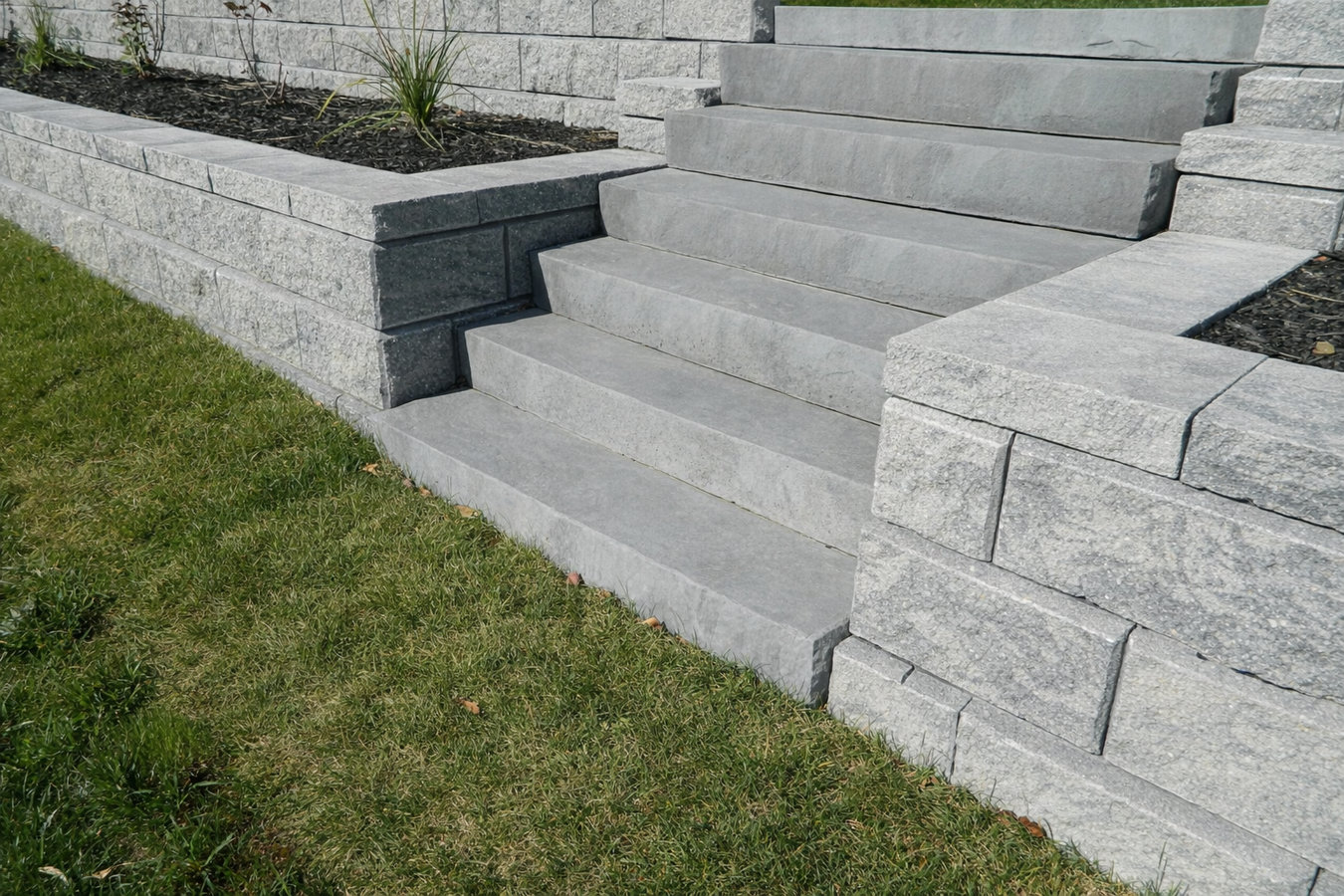
Springfield's residential neighborhoods — Forest Park, McKnight, the South End — are packed with Victorian, Colonial Revival, and early 20th-century triple-deckers, many with front steps that are decades past their serviceable life. Crumbling mortar beds, root-heaved slabs, and corroded original reinforcement are common on these properties. We assess the existing conditions before any forming starts, so demo costs and subgrade issues are priced upfront — not added as surprises at the end. For properties where the steps meet a concrete sidewalk, we can coordinate both scopes in one project. If the entry area also includes a wall or grade change, we often recommend pairing step work with concrete retaining walls to address the full site at once.
Signs Your Concrete Steps Need Replacement
The most visible sign is surface scaling — thin flakes of concrete peeling from tread surfaces after freeze-thaw cycles, indicating the original mix lacked air entrainment. Deep cracks running through the full thickness of a tread or riser, especially cracks that widen each spring, signal structural failure rather than surface wear. Steps that have tilted or separated from the building foundation mean the original footing never reached Springfield's required 48-inch depth, and frost heave has been pushing the slab upward each winter. Non-uniform riser heights — steps that vary more than 3/8 inch in height — are both a trip hazard and a building code violation under the Massachusetts Residential Code. If you notice any of these conditions, acting now is less expensive than waiting until total collapse forces emergency replacement.
How We Build Concrete Steps in Springfield
Every job starts with demolition and hauling away the old steps and any compromised subbase material. We excavate to undisturbed soil and install a compacted crushed-stone base — typically 4 to 6 inches — to promote drainage and prevent differential settlement. On most Springfield properties where the steps attach to the foundation, we excavate footing pockets to the full 48-inch frost depth required by Massachusetts Building Code, forming and pouring the footing before setting the step forms. This depth requirement is strictly enforced during Springfield Building Department inspections.
Forms are built to the IRC's stair geometry standards: risers no taller than 7¾ inches, treads at least 10 inches deep, and maximum 3/8-inch variation between any two risers or treads in the same flight. Deformed steel rebar — typically No. 4 bars — is placed in a grid with 1.5 to 2 inches of cover to resist cracking and prevent corrosion from the road salt and de-icers commonly used on Springfield front entries. The ACI 318 structural concrete code governs mix design and reinforcement placement for all structural concrete, including exterior stair systems that attach to or support a building.
Concrete is poured at 4,000 psi with 5–7% air entrainment and a water-to-cement ratio kept below 0.45 to limit permeability against de-icing chlorides. A broom finish is applied to all treads for wet-surface slip resistance — smooth-troweled finishes are avoided on exterior stairs per ACI recommendations. After the seven-day cure period, a penetrating sealer is applied to block chloride ingress before the first winter. For entries that connect to a concrete sidewalk, we form the joint between the steps and the walk with compressible expansion joint material to allow independent thermal movement. Where the entry grade requires level changes beyond the steps themselves, concrete retaining walls can be added to stabilize the surrounding soil and complete the site.
Concrete Steps Construction Across Springfield's Older Neighborhoods
Springfield's housing stock is among the oldest in the Pioneer Valley. Forest Park, McKnight, and the South End contain dense concentrations of Victorian, Colonial Revival, and triple-decker homes — many with original brick or masonry front steps that are well past their service life. The Connecticut River Valley's continental climate brings 30-plus freeze-thaw cycles each winter, making road-salt-resistant, air-entrained concrete the only practical specification for any new step installation in the area.
Springfield requires permits for structural step work, and the Building Department enforces the Massachusetts State Building Code 9th Edition. We serve homeowners and property managers throughout the city and surrounding communities, including Holyoke, Westfield, and Ludlow, where similar aging housing stock creates the same demand for code-compliant step replacement.
What to Expect When We Build Your Concrete Steps
Phone Consultation
We discuss your existing step condition, property type, and timeline. No commitment required.
On-Site Assessment
We inspect existing steps, measure the opening, assess footing conditions, and provide a written itemized quote — including any demo or subgrade work.
Permit & Scheduling
We pull the required Springfield building permit before any demolition begins. You don't need to visit the city office.
Build & Cure
Active work takes 2–3 days. Steps are safe for normal foot traffic after 7 days. Standard residential replacements typically run $1,500–$5,000 depending on scope and footing depth.
Get a Free Concrete Steps Estimate
We assess existing conditions on-site, give you an honest written quote — including demo, footing depth, and material costs — and handle the permit. No surprise add-ons on completion day.
(413) 334-1135Why Springfield Property Owners Choose Us for Concrete Steps
Full 48-Inch Frost Depth — Every Time
We never cut corners on footing depth. The 48-inch requirement is non-negotiable in Massachusetts and is inspected by Springfield's Building Department. Shallow footings are the primary cause of step tipping.
Transparent Demo-to-Finish Pricing
We assess original step conditions on triple-deckers and older homes before quoting — so demo costs, root removal, and rebar remediation are in the proposal upfront, not added at the end.
Permitted, Licensed, and HIC-Registered
We hold both a Massachusetts CSL and HIC registration, both required by state law for structural residential step work. We pull permits before breaking ground on every project.
Air-Entrained Mix Specifications
Every step project uses 4,000 psi air-entrained concrete with a water-to-cement ratio under 0.45 — the specification proven to resist Springfield's road salt and freeze-thaw conditions for decades.
Concrete Steps FAQ — Springfield, MA
Related Services
Replace Your Concrete Steps Before Another Springfield Winter
Cracked, heaving, or scaling steps don't improve on their own. We'll assess your situation, pull the permit, and build steps that stay level and safe — built to the frost depth and mix specifications Springfield actually requires.