Slab Foundation Building in Springfield, MA — Engineered for Pioneer Valley Soils
Pouring a concrete slab foundation in Springfield is not the same as pouring one in a warmer state. Massachusetts mandates a 48-inch frost depth, the Stretch Energy Code requires under-slab insulation, and the Connecticut River Valley's glaciolacustrine soils demand verified sub-base preparation. We handle every step — permit, sub-base, insulation coordination, pour, and inspection — so your foundation is built right from the first shovel to the final inspection.
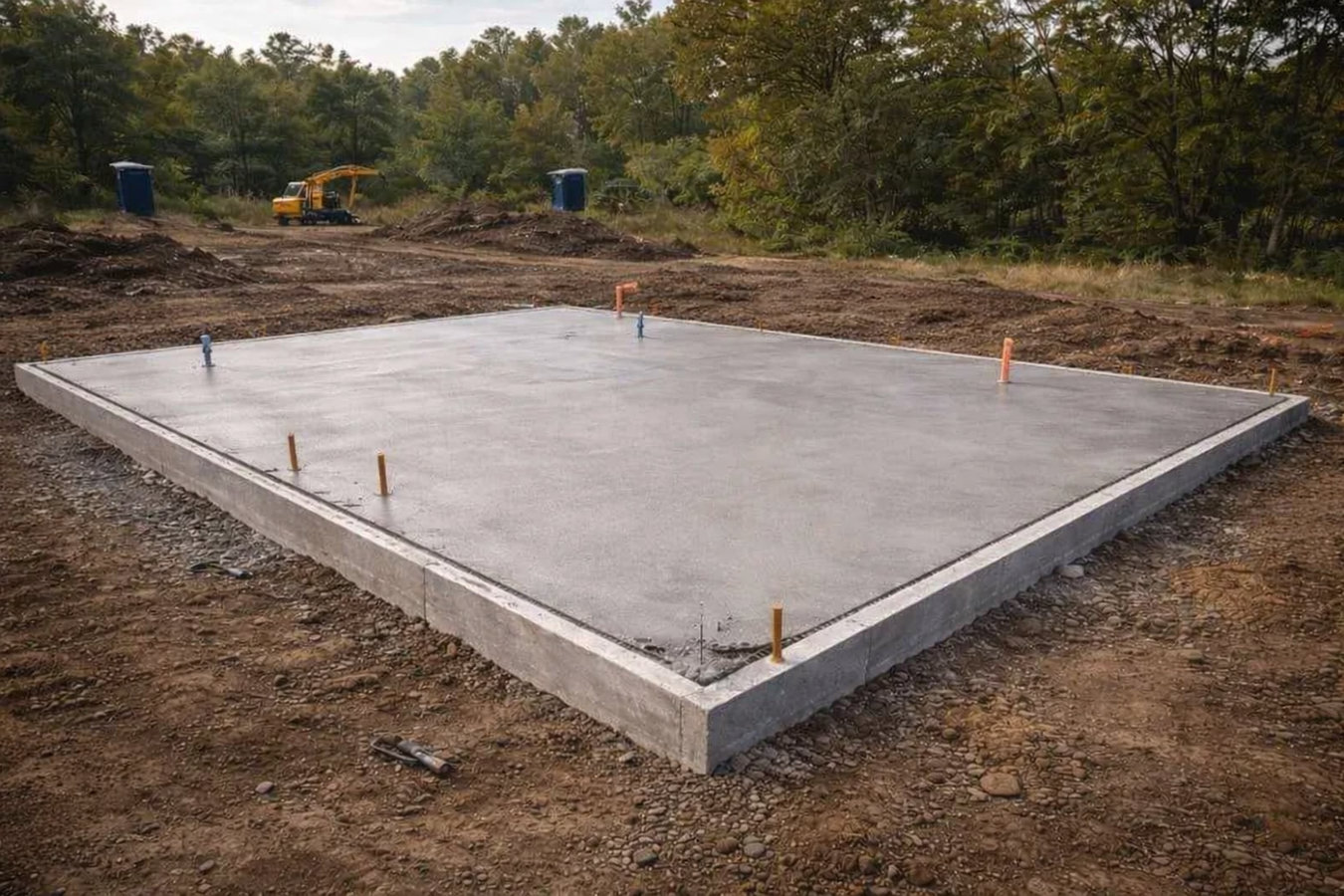
Whether you're adding a ground-level addition, a garage conversion, or an accessory dwelling unit to a Springfield property, a correctly built slab foundation is the difference between a structure that stays true for 40 years and one that cracks within five. The glaciolacustrine silts and clay varves that underlie much of Springfield and the broader Pioneer Valley require sub-base engineering that a standard residential pour spec does not address on its own. Once the slab is in place, the next step is typically foundation installation — the full wall system — or concrete footings for supporting structural loads above.
When You Need a New Slab Foundation
New construction projects — additions, garages, ADUs, and detached outbuildings — require a slab foundation before framing can begin. In Springfield's Metro Center, Upper Hill, and South End neighborhoods, many existing garage slabs and ground-level addition pads were poured decades ago without adequate reinforcement, vapor barriers, or frost-depth compliance, and they now show significant differential settlement or full structural cracking. An existing slab that has settled more than an inch at any point, shows cracks wider than 1/4 inch, or has heaved significantly at the perimeter usually warrants replacement rather than repair. Starting fresh with a properly engineered slab is almost always more cost-effective than trying to stabilize or overlay a fundamentally compromised base.
How We Build Slab Foundations in Springfield
The first step is a site visit to characterize the existing subgrade conditions. Springfield's proximity to the Connecticut River and its glaciolacustrine soil history means we never assume standard bearing capacity; we probe to verify soil type and compressibility before finalizing footing dimensions. The perimeter footings are then excavated to the state-required 48-inch frost depth per Massachusetts Building Code 780 CMR Table R301.2(1), forming and pouring the grade beam before the interior sub-base work begins.
A 4- to 6-inch compacted crushed-stone sub-base is placed and mechanically compacted in lifts to provide uniform bearing and promote drainage. For projects subject to the Massachusetts Stretch Energy Code, rigid closed-cell foam insulation is installed over the sub-base before the vapor barrier and reinforcement go in. A Class A polyethylene vapor retarder of at least 10 mils thickness is then laid per ASTM E1745 to block ground moisture migration into the slab — a step often skipped on older Springfield construction that leads to flooring failures and mold beneath finished floors.
Reinforcement is typically #4 rebar on 18-inch centers in both directions for residential foundation slabs, per ACI 318 and the Massachusetts Residential Building Code. Concrete is poured at a minimum 3,500–4,000 psi with a low water-to-cement ratio and appropriate air entrainment for the IECC Climate Zone 5 exposure class. Control joints are placed at intervals no greater than 10–12 feet per ACI 302.1R, directing shrinkage cracks into planned lines rather than across the slab face. Once the slab is poured and cured, the next phase is often foundation installation — adding the wall system to complete the structural base — or concrete footings for point loads above.
Slab Foundation Building in Springfield and the Pioneer Valley
Springfield falls in IECC Climate Zone 5, making it subject to the Massachusetts Stretch Energy Code's under-slab insulation requirements for new residential construction. The 48-inch frost depth mandated by 780 CMR adds meaningful excavation and concrete volume costs compared to lower-frost-depth markets — a difference that shows up immediately in any budget comparison with southern states. The fine silts and clay varves left by glacial Lake Hitchcock across much of the Pioneer Valley are the most common cause of unexpected differential settlement when sub-base preparation is treated as an afterthought.
We pour slab foundations throughout Springfield and serve customers in neighboring communities including East Longmeadow, Agawam, and West Springfield, where the same soil and code conditions apply.
What to Expect From a Slab Foundation Project
Site Assessment
We evaluate soil conditions, drainage, and frost depth requirements before any design decisions are made.
Written Quote
You receive an itemized proposal covering excavation, sub-base, insulation, vapor barrier, rebar, concrete, and finishing — no hidden items.
Permit & Inspections
We submit to the Springfield Building Department and schedule the required footing, sub-base, and pour inspections. You don't need to coordinate with the city.
Pour & Cure
Active site work runs 3–5 days. Framing can typically begin around day 7 for light loads; the full 28-day cure is required for structural loading. Project costs commonly run $12,000–$28,000 for a standard residential footprint.
Get a Free Slab Foundation Estimate
Tell us about your project and we'll schedule an on-site visit, assess soil conditions, and provide a written quote that accounts for Springfield's frost depth and energy code requirements — no surprises.
(413) 334-1135Why Springfield Customers Choose Us for Slab Foundation Work
Footings Dug to the Full 48-Inch Frost Depth
We never cut depth to save time. The 48-inch requirement is inspected by the Springfield Building Department, and a footing that stops short will heave, crack, and cost far more to repair than it saved at build.
Sub-Base Engineered for Pioneer Valley Soils
The fine silts and clay deposits left by glacial Lake Hitchcock require a verified, compacted sub-base — not a standard dump of gravel. We assess sub-surface conditions before finalizing sub-base depth and material specifications.
Stretch Energy Code Compliance Handled Start to Finish
We coordinate under-slab insulation specifications and inspection scheduling with the Springfield Building Department so your certificate of occupancy isn't delayed by an energy code deficiency.
CSL-Licensed Supervision on Every Project
All foundation work is supervised by a Massachusetts Construction Supervisor License (CSL) holder — required by 780 CMR. You can verify our license standing on the Mass.gov portal before signing anything.
Slab Foundation FAQ — Springfield, MA
Related Services
Ready to Pour a Slab Foundation in Springfield?
Get a written estimate that accounts for the full scope — frost depth, sub-base, insulation, vapor barrier, rebar, and permit. We handle the Springfield Building Department paperwork so your project moves without delays.